
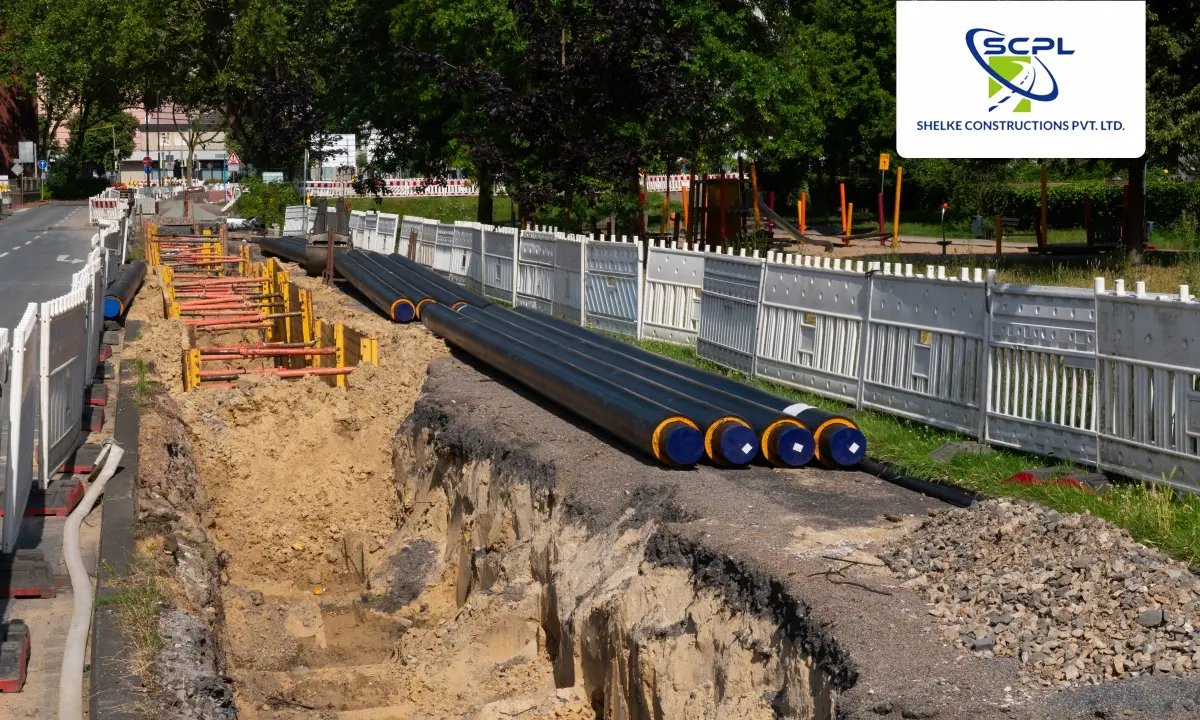
Road Work Near Your Area is not just about smoother driving. It is about whether your street turns into a river every monsoon, whether your society gate becomes a lake, and whether your shopfront stays dry or gets flooded. Most “flooding problems” are not because rain is new. They happen because water has no planned path to move. When roads are raised without drainage, when drains are blocked, or when culverts are missing or undersized, water gets trapped. Then it attacks the road from below, softens the soil, breaks the edges, and turns cracks into potholes.
At Shelke Constructions, we look at roads like a complete system: pavement plus drainage plus crossings plus outlets. This guide explains Road Work Near Your Area in full layman language so you can understand why culverts and drainage decide flooding control more than the final asphalt layer.
Want to see how we approach infrastructure execution as a system, not a patchwork job?
Explore our infrastructure approach
The simple truth: roads do not fail first, water does
When people complain about Road Work Near Your Area, they usually say “the road is bad.” But what actually happens is this:
- Rainwater sits on the surface because there is no slope or the drain is blocked
- Water seeps into the side edges and under the road
- The soil below becomes soft like soaked biscuit
- Heavy vehicles press the road down and the surface cracks
- Cracks invite more water, and the road collapses faster
Metaphor: A road without drainage is like a roof without a gutter. Even if the roof is new, water will find a way to drip, stain, and weaken the structure.
If you want long-lasting Road Work Near Your Area, you do not just “blacktop.” You create a controlled route for water to exit.
What drainage actually means for a normal person
Drainage is not only “a drain on the side.” In Road Work Near Your Area, drainage includes:
- Surface slope (camber)
The road must be slightly higher in the center so water runs to the sides. - Side drains
Channels that carry water along the road line, not across your road. - Cross drainage (culverts)
Paths that allow water to pass from one side to the other under the road. - Outlets
The final connection to a larger drain, nalla, storm line, or soak pit system.
If any one part is missing, water stagnates. That is why Road Work Near Your Area needs culverts and outlets, not just a drain that ends nowhere.
Culverts, explained like you are 12 years old
A culvert is a tunnel for water under the road.
That is it.
In Road Work Near Your Area, a culvert is what stops water from getting trapped on one side. Without it, rainwater piles up, enters plots, floods basements, and creates those ugly, repeated potholes right near low points.
Metaphor: Think of a culvert like a straw under the road. If the straw is missing, bent, blocked, or too small, the water will spill over everywhere.
Common culvert types you will see
- Pipe culvert: round RCC pipe under the road
- Box culvert: rectangular RCC opening for larger flows
- Slab culvert: slab supported on walls for moderate spans
For layman impact, do not worry about the type. Worry about whether it is sized right, placed at the right point, and connected to a real outlet.
At Shelke Constructions, culverts are treated as essential infrastructure, not “small side items,” because the whole road depends on them.
Why your area floods after roadwork, even if the road looks new
Here are the most common reasons Road Work Near Your Area makes flooding worse:
1) Road level got raised, but drains did not
The road becomes a speed breaker for water. Your plot becomes the low point.
2) Drain exists, but it is too shallow or wrongly sloped
Water sits in the drain like a dead-end canal.
3) Culverts are missing, undersized, or blocked
Water cannot cross the road, so it collects and spills into nearby buildings.
4) No outlet connection
This is the biggest joke in many projects. A drain that does not connect to anything is a decorative line.
5) Debris and silt are ignored
Drains choke up because cleaning was not planned, or construction waste fell in and stayed there.
Metaphor: A drain without an outlet is like a WhatsApp message that never gets sent. It exists, but it solves nothing.
What good roadwork should include (the public checklist)
If you are watching Road Work Near Your Area, this is what you should look for. You do not need technical knowledge. You need common sense.
A) Water must have a clear direction
- The finished road should show a slight slope to the drain
- Water should not sit in random patches after a small rain
B) Side drains must be continuous
- No sudden missing sections
- No drain that ends without a connection
C) Culverts at low points and natural flow paths
- Wherever water naturally crosses, a culvert or crossing must exist
- Inlets should be protected so debris does not block them
D) Proper shoulders and edge protection
Road edges fail first when water enters from the side. Shoulders must be compacted and protected.
E) Maintenance plan
Even the best drain fails if it is never cleaned. Regular desilting is part of real flooding control.
At Shelke Constructions, this system mindset is how we reduce repeat failures. Because the goal is not “nice today,” it is “works in the next monsoon too.”
The hidden benefit: drainage reduces potholes and saves money
Here is the thing most people miss about Road Work Near Your Area. Drainage is not only for flooding. It also:
- keeps the soil under the road strong
- reduces cracks and potholes
- improves road life
- lowers repair cycles
- protects nearby properties from seepage
Metaphor: Drainage is like good sleep. You do not notice it daily, but your whole system collapses without it.
If your local road keeps failing every monsoon, it is almost always a drainage issue wearing an asphalt costume.
What you can do as a citizen or society committee
You cannot redesign highways, but you can ask better questions during Road Work Near Your Area:
- Where is the water supposed to go from this road?
- Is the side drain connected to an outlet?
- Where are the culverts located, and are they at low points?
- What is the plan for cleaning silt and debris?
- How will the road level affect nearby plot entries and basements?
Even one site meeting with these questions can prevent years of flooding complaints.
If you want a practical site review and recommendations for drainage improvements:
Get in touch here
The takeaway
Road Work Near Your Area should never be judged only by the top surface. A smooth black layer can still flood, still fail, and still become a pothole factory if drainage and culverts are ignored. Flood control is not magic. It is just planned movement of water: slope, drain, culvert, outlet. When those four connect properly, your road survives monsoon with dignity.
At Shelke Constructions Pvt Ltd, this is exactly how we think about road execution: build the path for water first, then build the road.
FAQs
1) Why did my area start flooding after a new road was built?
Because road levels often rise while drainage and culverts stay unchanged. Water then gets trapped and spills into nearby plots.
2) What is a culvert in simple words?
A tunnel for water under the road. Without it, water collects on one side and causes flooding and potholes.
3) Can a road have drains and still flood?
Yes, if drains are not connected to an outlet or have the wrong slope. A drain that ends nowhere is not a solution.
4) Why do potholes keep forming near the same spots?
Those spots usually have water stagnation or seepage under the road. Fix drainage and culverts, and potholes reduce drastically.
5) What should I check during roadwork near my home?
Check slope, continuous drains, culverts at low points, and a real outlet connection. If water has no exit, flooding is guaranteed.