
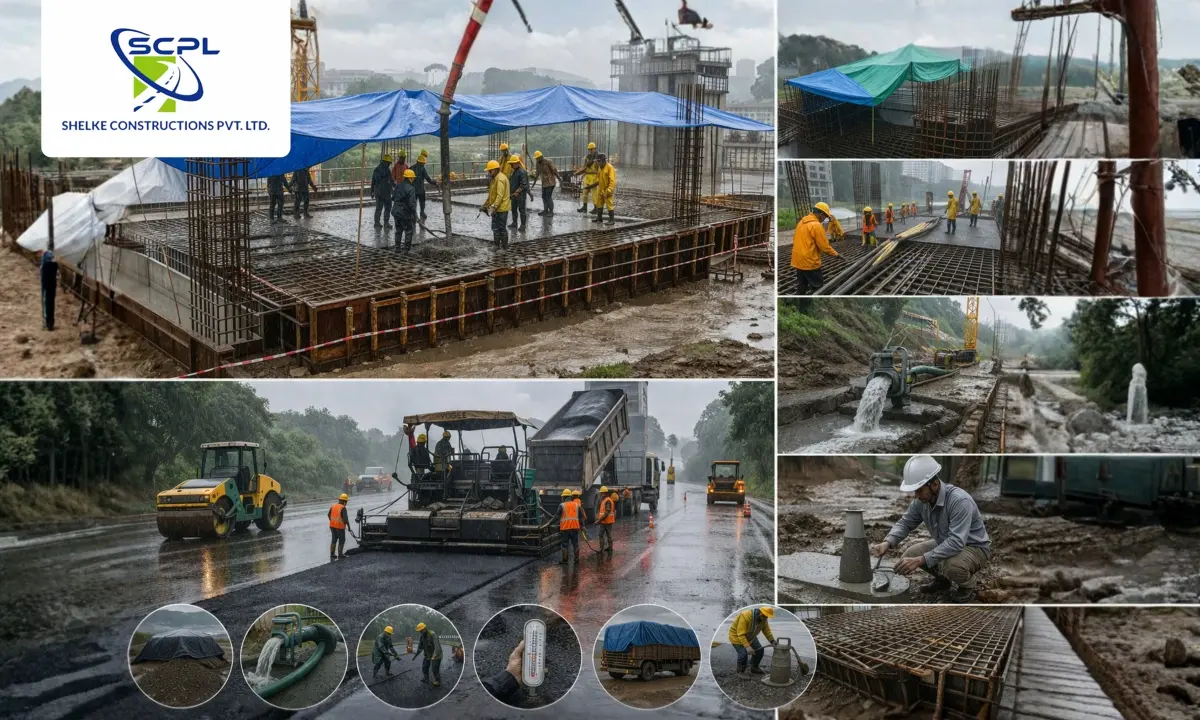
Building Through the Monsoon is where most projects in Pune and Maharashtra either prove their planning, or pay for shortcuts later. Rain does not just slow work. It changes soil behavior, concrete setting, curing conditions, material storage, and road layer compaction. If you plan properly, monsoon construction can still move forward safely. If you do not, you get honeycombing, leakage, weak subgrades, rutting, potholes, and endless rework. This guide on Building Through the Monsoon gives practical RCC and road construction precautions that actually work on real sites.
At Shelke Constructions, monsoon planning is treated like a separate execution mode, with tighter checklists, protection measures, and sequencing. The goal is simple: keep quality stable even when weather is not.
Why monsoon changes everything on site
Building Through the Monsoon is challenging because rain introduces two enemies at once: extra water where you do not want it, and delays where you do.
Common monsoon risks:
- Concrete surfaces get washed or disturbed before setting
- Formwork joints leak, causing grout loss and honeycombing
- Soil becomes soft, causing settlement and edge failures
- Road layers trap moisture, reducing compaction and strength
- Storage areas flood, damaging cement, steel, and aggregates
- Slippery access increases safety risk
Metaphor: Monsoon turns a construction site into a kitchen with a leaking ceiling. Even if you cook well, you must first stop water from falling into the food.
Part A: RCC precautions that actually work in monsoon
1) Stop treating rain as a surprise
The most important Building Through the Monsoon precaution is planning pours around forecast windows and site readiness.
Do this:
- Keep a weekly pour plan with alternative dates
- Avoid large slab pours when heavy rainfall is expected
- Plan early morning pours when conditions are more stable
- Ensure pump lines, mixers, and vibrators are ready to avoid long exposure time
At Shelke Constructions, pour approvals are tied to site readiness, not just calendar dates, especially during monsoon.
Want a snapshot of how our project planning and approvals are structured?
See how we work
2) Protect formwork like it is part of the structure
In Building Through the Monsoon, shuttering and formwork take more stress. Water finds gaps and leaks out cement slurry. That is how honeycombing begins.
Practical precautions:
- Seal shutter joints properly to prevent grout leakage
- Check props, bracing, and base plates on stable ground
- Cover formwork zones with tarpaulin where possible
- Keep spare wedges, clamps, and supports ready on pour day
Quick common sense test: If you can see a gap, water can see it too.
3) Control water in concrete, do not “adjust on the spot”
Rain makes people casually add or remove water, which is risky.
Building Through the Monsoon best practice:
- Do slump tests more frequently during rain periods
- Avoid uncontrolled site water addition
- Keep admixture dosage as per approved mix design
- If rain hits fresh concrete, do not keep finishing it blindly, pause and protect
Concrete that looks workable because it is wet from rain is not the same as concrete designed for workability.
4) Cover fresh concrete immediately after finishing
Fresh concrete is like wet rangoli. One rain splash can ruin the surface and create weak patches.
Precautions:
- Keep tarps, plastic sheets, and supports ready before the pour starts
- Protect slab edges and corners first, they are most vulnerable
- Stop surface finishing if rain is actively washing cement paste
- Resume only when conditions are stable and the engineer approves
5) Curing is easier in monsoon, but do it correctly
People assume rain means curing is automatic. Not true.
Building Through the Monsoon curing precautions:
- Ensure water does not pond in unwanted areas and create slope issues
- Do controlled curing, not random water accumulation
- In heavy rain, protect curing surfaces from erosion or slurry loss
- Continue curing routine even if weather feels “wet”
At Shelke Constructions Pvt Ltd, curing and protection are treated as quality steps, not optional site habits.
Part B: Road construction precautions that work in monsoon
1) Do not fight wet soil, manage it
Building Through the Monsoon for roads is mostly about moisture control. Compaction on wet soil is like trying to compact sponge cake. It looks flat, but it rebounds and fails later.
Practical actions:
- Test and control moisture before compaction
- Remove soft spots immediately, do not “roll it and hope”
- Provide temporary drainage so water does not sit on the formation
- Protect subgrade from repeated saturation with a working layer if needed
2) Keep layers thin and controlled, not thick and rushed
For GSB and WMM layers, wet conditions increase segregation risk and reduce density.
Precautions:
- Lay material in specified thickness only
- Compact in correct passes and do density checks
- Avoid laying during active heavy rainfall
- Cover stockpiles and keep material contamination-free
3) Drainage first, asphalt later
This is the most important Building Through the Monsoon rule for roads. If water has no path, the road becomes a pothole factory.
- Ensure side drains are open and continuous
- Ensure culverts are functional and not blocked
- Ensure outlets are connected so drains do not end nowhere
- Ensure shoulders are compacted to prevent edge seepage
Metaphor: Asphalt is the shirt. Drainage is the skin. If the skin is infected, the shirt will not fix it.
At Shelke Constructions, road works are planned as a drainage system plus pavement layers, not as a topping activity.
4) Be careful with bituminous work in high humidity and rain
Asphalt laying needs dry surfaces and temperature control. Trapped moisture causes stripping, weak bonding, and early failures.
Precautions:
- Do not lay tack coat on wet surfaces
- Avoid bituminous laying during rain or when rain is imminent
- Ensure proper surface drying before any coat application
- Focus on joint quality and compaction window
5) Safety is not a poster, it is a system
Monsoon sites are slippery. Falls and electric hazards increase.
Safety must-haves:
- Anti-slip access paths and proper lighting
- Barricading near excavations and open drains
- Proper electrical insulation and safe temporary wiring
- PPE enforcement and toolbox talks during rainy weeks
At Shelke Constructions, monsoon safety routines are tightened because one incident can shut down progress and damage trust.
Monsoon planning checklist you can actually use
Building Through the Monsoon becomes manageable when you follow a repeatable checklist:
- Rain-ready pour plan with backup dates
- Tarpaulin and protection materials ready before pouring
- Formwork sealed and supports rechecked
- Slump tests and cube sampling discipline maintained
- Controlled curing and surface protection
- For roads: moisture-controlled compaction and drainage continuity
- Daily site housekeeping, because blocked paths and silted drains cause chaos
Need a project plan that accounts for monsoon realities upfront?
Get in touch with our team
FAQs
1) Can RCC work continue safely during monsoon?
Yes, if pours are planned around windows, and fresh concrete is protected immediately. The mistake is pouring without protection readiness.
2) What is the biggest RCC risk in monsoon?
Grout washout and shutter leakage leading to honeycombing, plus finishing damage from sudden rain. Prevention is easier than repair.
3) Can road construction be done in monsoon?
Some stages can, but moisture control is critical and heavy rain windows should be avoided. Drainage work usually becomes the top priority.
4) Why do new roads fail faster after monsoon work?
Wet subgrade, poor compaction, and trapped moisture under asphalt are common reasons. Without drainage continuity, failures repeat at the same spots.
5) What should clients insist on during monsoon projects?
Written monsoon precautions, clear quality checks, and a realistic schedule buffer. Rain is not an excuse, it is a condition to plan for.