
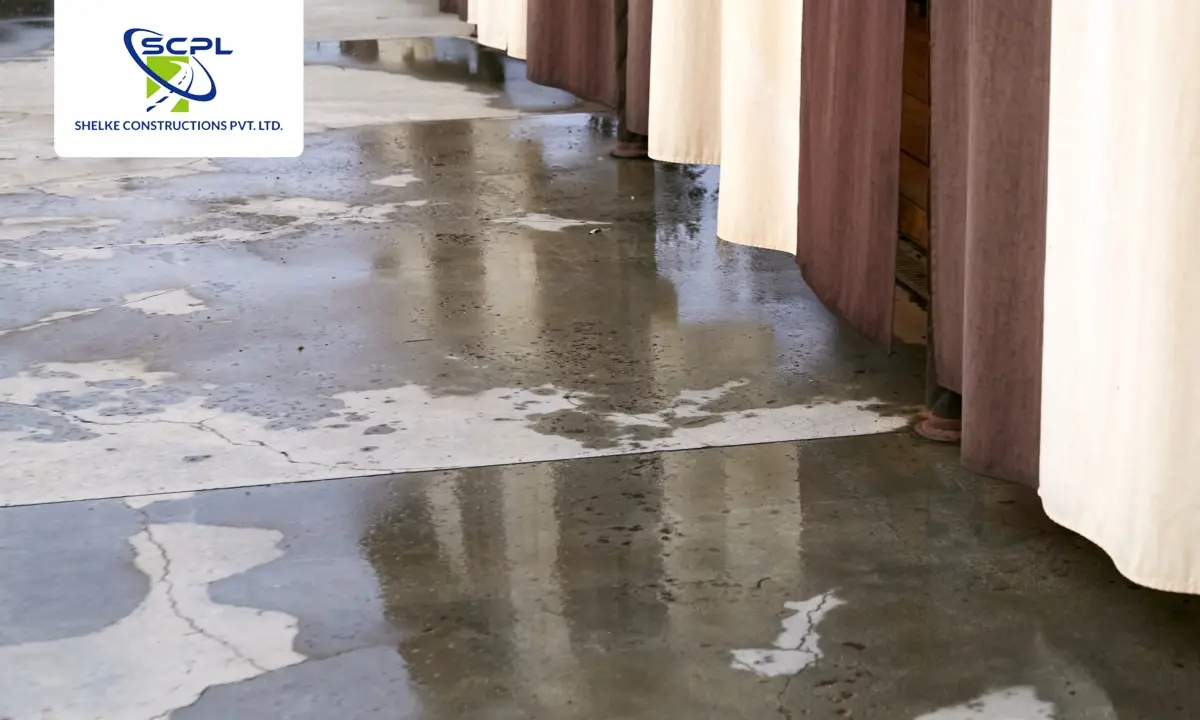
Water Leakage in Slab or Terrace is one of the most frustrating building problems because the leak rarely shows exactly where the water enters. You see a damp patch in the ceiling, peeling paint, or dripping in the corner, but the actual entry point might be 5 to 15 feet away. Water travels. It seeps along cracks, reinforcement lines, and slab slopes until it finds a weak spot, then it shows up like a “mystery stain.”
At Shelke Constructions, we treat terrace leakage like an investigation, not a quick coating job. This guide on Water Leakage in Slab or Terrace explains common causes, simple diagnosis steps, and fix options that actually work.
Want to understand how we plan waterproofing and execution to avoid repeat leakage? Explore our work approach
First, understand how terrace leakage usually behaves
Water Leakage in Slab or Terrace typically follows patterns:
- Leak appears only during heavy rain: likely terrace or external wall entry
- Leak appears even without rain: could be overhead tank, plumbing, or wet area leakage
- Leak increases when terrace water ponds: slope or outlet issue
- Leak appears along a beam line: water is traveling through a crack/joint and collecting at a structural line
Metaphor: water is like a cat. If it finds a tiny gap, it will squeeze through and then roam inside until it finds the easiest exit.
Common causes of water leakage in slab or terrace
1) Cracks in slab or parapet junction
Hairline cracks can look harmless, but they become water entry lines. Cracks often form at:
- slab-parapet joint
- corners and re-entrant edges
- near pipe sleeves and penetrations
- construction joints
If you have Water Leakage in Slab or Terrace and you see cracks near the parapet edge, treat it seriously. Edge joints are common weak points.
2) Failed waterproofing membrane or coating
Waterproofing systems fail when:
- surface preparation was poor
- waterproofing was applied too thin
- laps and joints were not detailed
- protection screed was not done properly
- UV exposure damaged unprotected coatings
A “new coating” over an old failed layer often traps moisture and fails again.
3) Wrong slope and water ponding
Terraces must drain quickly. If water stands for hours, it increases pressure on the waterproofing system. Ponding is one of the biggest triggers of Water Leakage in Slab or Terrace.
Common slope problems:
- low spots near outlets
- reverse slope towards parapet
- broken khurras (drain mouth detailing)
4) Outlet and rainwater pipe issues
Sometimes the waterproofing is fine, but the outlet is the problem:
- outlet joint is not sealed
- rainwater pipe is cracked or loose
- outlet mouth is blocked and water rises above safe level
Metaphor: even a good bathtub leaks if the drain connection is loose.
5) Parapet wall cracks and coping issues
Parapets take heat and rain directly. If coping is cracked, plaster is loose, or drip moulding is missing, water can enter and travel down.
6) Plumbing, tank, or solar penetration leaks
If terrace has:
- overhead tank base leakage
- solar water heater pipes
- AC outdoor unit drain lines
- any newly drilled anchors
these penetrations are common leakage points.
At Shelke Constructions, we always check penetrations and sleeves early, because one unsealed hole can defeat the whole waterproofing system.
Quick diagnosis: what you can do before calling someone
If you suspect Water Leakage in Slab or Terrace, do these simple steps first:
Step 1: Map the leak
- mark the damp patch edges with pencil
- write the date
- see if it grows after rain
Step 2: Check terrace after a rain
Look for:
- ponding areas that remain wet longer
- visible cracks and open joints
- broken tile grout or hollow tile sounds
- dampness at parapet base
Step 3: Check outlet and rainwater pipe
- pour a bucket of water near the outlet
- see if it drains quickly
- check if water escapes around the pipe joint
Step 4: Rule out plumbing
If leakage happens even in dry weather, check:
- overhead tank overflow
- bathroom sunken area leakage
- wet area seepage traveling to slab
This basic diagnosis helps you avoid the most common mistake: treating terrace leakage when the real source is plumbing.
Fix options that actually work (choose based on the cause)
Water Leakage in Slab or Terrace cannot be solved with one universal method. Below are fix options, from small to full-system.
Fix option 1: Crack sealing and joint treatment (localized)
Best when:
- leakage is minor and crack-driven
- waterproofing system is otherwise healthy
Typical approach:
- open the crack slightly and clean it
- fill with suitable crack filler or injection material
- treat slab-parapet joint properly
- recoat the treated zone with compatible waterproofing
This is not “putty and paint.” It must be a waterproofing-grade repair.
Fix option 2: Khurra and outlet detailing correction
Best when:
- leakage is around drain mouths
- water is ponding near outlets
Typical approach:
- redo the khurra detailing (drain mouth)
- ensure correct slope to outlet
- seal pipe joint properly
- apply waterproofing in that zone with proper lap
Many Water Leakage in Slab or Terrace cases are solved here because outlets are classic failure points.
Fix option 3: Re-screeding with proper slope + waterproofing
Best when:
- ponding is widespread
- slope is wrong across terrace
Typical approach:
- remove top layer if needed
- create proper slope screed
- apply waterproofing membrane/system
- add protective layer (screed/tiles) as per system
Metaphor: if your terrace slope is wrong, coatings are like umbrellas inside a house. The water still sits where it shouldn’t.
Fix option 4: Full terrace waterproofing system redo
Best when:
- old waterproofing has failed in multiple places
- repeated repairs have failed
- leakage is widespread and recurring
Typical approach (system-dependent):
- remove loose layers, repair cracks
- apply primer and waterproofing membrane or coating system
- treat all joints, corners, parapet base, and penetrations
- do a pond test where applicable
- protect the system with screed/tiles
At Shelke Constructions, full-system redo is recommended only when diagnosis shows patch repairs will keep failing. Otherwise clients spend repeatedly.
Want to understand waterproofing options and what suits your terrace?
Explore our services
Fix option 5: Parapet wall repairs and coping improvement
Best when:
- leakage travels from parapet
- cracks appear on coping and wall plaster
Typical approach:
- repair parapet cracks
- redo coping with proper slope and drip detailing
- seal joints at parapet-slab junction
- ensure external wall protection and paint system is correct
What not to do (these create repeat leakage)
If you want to stop Water Leakage in Slab or Terrace, avoid:
- applying a new coating over loose or wet surfaces
- tiling over a leaking terrace without waterproofing correction
- ignoring slope and ponding because “coating will handle it”
- sealing only the ceiling patch from inside the flat
- drilling new anchors into waterproofing without resealing
Metaphor: fixing terrace leakage from inside is like drying the floor while the tap is still running.
A practical prevention checklist for terraces
To reduce future Water Leakage in Slab or Terrace:
- keep outlets clean before monsoon
- avoid ponding by correcting slope early
- seal any new penetrations immediately
- inspect parapet coping and joints annually
- do minor crack treatment before it becomes a leakage path
At Shelke Constructions Pvt Ltd, prevention is always cheaper than repeat repair cycles.
Need a terrace leakage inspection and fix recommendation?
Get in touch here
FAQs
1) Why does water leakage show inside far from the terrace crack?
Water travels along the slab and reinforcement lines before it finds an exit point. The visible damp patch is often not directly under the entry point.
2) Can I fix terrace leakage by painting the ceiling from inside?
No, that only hides the symptom. The water entry point must be treated from the terrace side or the actual source side.
3) Is tile grout enough to stop terrace leakage?
No. Grout is not a waterproofing system and cracks over time. Waterproofing needs membrane or coating systems with joint detailing and protection layers.
4) What is the most common terrace leakage cause in Pune and similar climates?
Ponding due to wrong slope and failure at outlet/khurra detailing are very common. Cracks at parapet junctions are also frequent.
5) When should I choose full terrace waterproofing redo instead of patch repair?
When leakage is recurring in multiple spots, the existing layer is failing widely, or earlier patches did not last. Diagnosis should guide this decision.