
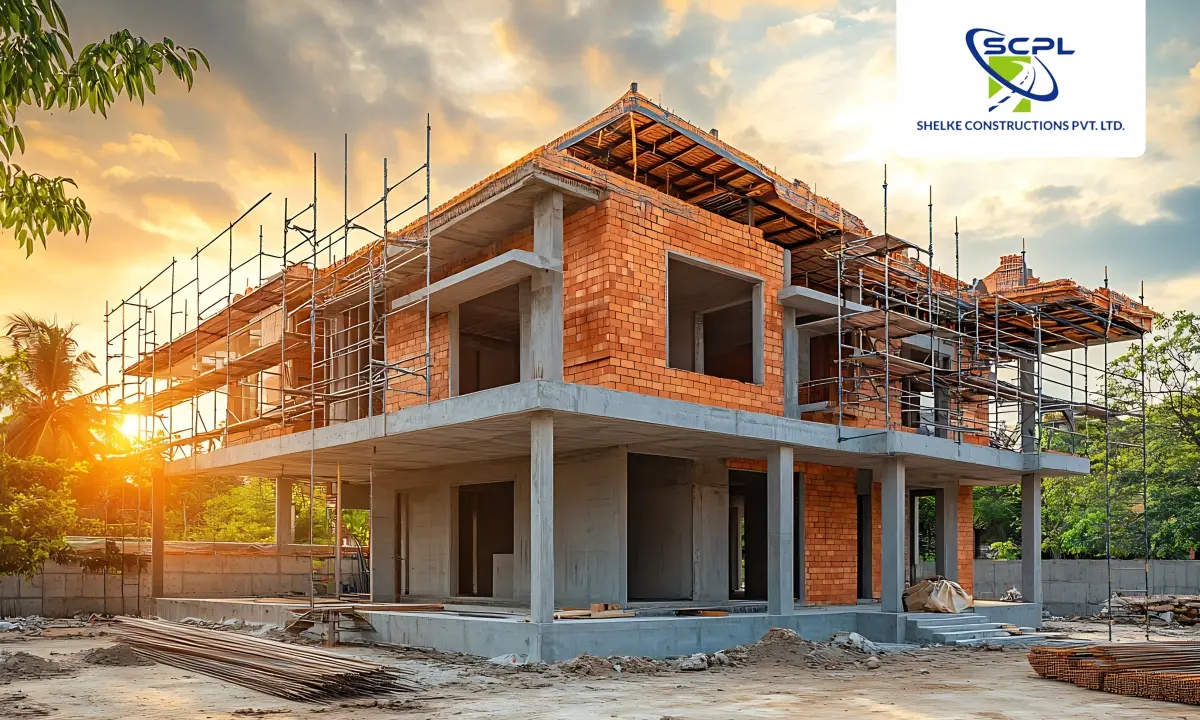
House Construction Timeline is the question every homeowner asks, and the honest answer is this: timelines are predictable only when scope is clear, decisions are timely, and the site is ready. A house is not built in one straight line. It is built in layers, like making a sturdy thali: you need the base first, then structure, then finishing, then the final details. This House Construction Timeline guide breaks down each stage in a simple way, so you know what takes time, what can overlap, and what usually causes delays.
At Shelke Constructions, we plan projects stage-wise with milestone checklists and clear handovers so clients see progress in real terms, not just dates on a calendar. Use this House Construction Timeline as a reference before you commit to a schedule or compare contractor promises.
Want to understand how we plan execution and milestones from day one?
See our work approach
The truth about timelines in Pune
A House Construction Timeline in Pune depends on plot conditions, approvals, design complexity, monsoon windows, and how quickly you choose finishes. Two houses of the same area can take very different time because one has a basement, heavy cantilevers, premium finishes, and frequent design changes, while the other is straightforward with clear decisions.
As a rule of thumb for a typical independent house, the build can range from 6 to 12 months, and for larger or more complex houses it can be longer. Your timeline becomes more predictable when scope and drawings are final before construction begins, which is how Shelke Constructions prefers to structure the start.
If you want a project plan that matches real site constraints:
Connect with our team
Stage 0: Pre-construction planning and approvals (2 to 8 weeks)
This stage decides whether your House Construction Timeline runs smooth or becomes stop-start.
What happens here:
- Finalizing layout, elevations, and structural design
- Soil testing and foundation approach planning
- Permissions and approvals depending on plot and authority requirements
- Contractor selection, budget finalization, agreement and milestones
- Setting up site access, temporary power and water, storage planning
What delays it:
- Late design changes
- Approval back and forth
- Unclear scope between core and shell vs turnkey
Metaphor: If you start cooking before prepping ingredients, the kitchen turns into chaos. Planning is the prep.
Stage 1: Site setup and excavation (1 to 2 weeks)
In a typical House Construction Timeline, this is when work becomes visible.
What happens:
- Site clearing, leveling, marking the building footprint
- Excavation for footings, plinth, sump, and septic or services
- Dewatering if needed, especially in monsoon or high water table zones
- Disposal or reuse planning for excavated soil
What delays it:
- Rock excavation or unexpected soil conditions
- Access constraints for machinery in narrow lanes
At Shelke Constructions, we prefer to identify these risks early so excavation does not become a surprise extension.
Stage 2: Foundations and plinth (3 to 5 weeks)
This is the stage that supports everything above, so it must not be rushed in the House Construction Timeline.
What happens:
- PCC and footing reinforcement
- RCC footings, pedestals, plinth beams
- Backfilling in layers with proper compaction
- Anti-termite treatment and damp proof course where specified
What delays it:
- Extra foundation depth due to soil conditions
- Rain interruptions and curing time
Metaphor: A strong building is like a strong tree. Roots first, height later.
Stage 3: RCC superstructure (8 to 16 weeks)
This is usually the longest chunk of the House Construction Timeline and the one people underestimate. Your floor count, slab spans, staircase complexity, and sequencing decide the duration.
What happens:
- Column, beam, slab cycles for each floor
- Staircase construction
- Curing and de-shuttering cycles
- Structural checks that must happen before pours
Typical pace:
- A slab cycle can take 10 to 20 days per floor depending on system, manpower, and complexity.
What delays it:
- Shortage of labour or formwork systems
- Rework due to poor shuttering or alignment
- Rain impacting slab pours and curing
At Shelke Constructions Pvt Ltd, the goal is to maintain rhythm and quality hold points, because rhythm reduces delays more than speed does.
Stage 4: Masonry and internal walls (4 to 8 weeks)
Once structure is up, the House Construction Timeline shifts into shape and space.
What happens:
- Brickwork or AAC blockwork for internal and external walls
- Chajja, parapets, and small civil detailing
- Opening sizes and alignment checks for doors and windows
What delays it:
- Changes in room sizes or late layout changes
- Material availability, especially specific blocks or sizes
Metaphor: Structure is the skeleton, masonry is the body. It gives the building its form.
Stage 5: Plaster, waterproofing, and external shell readiness (4 to 8 weeks)
This stage decides comfort and long-term durability, and it can extend the House Construction Timeline if waterproofing is done late.
What happens:
- Internal plaster and external plaster
- Terrace waterproofing, toilet waterproofing, balcony waterproofing
- Window fixing readiness, slope corrections, drain planning
What delays it:
- Water curing needs time
- Leakage testing cycles
- Monsoon interruptions for external plaster and terrace works
At Shelke Constructions, we prefer to treat waterproofing as a planned stage with testing, not as a last-minute patchwork item.
Stage 6: MEP rough-in (electrical and plumbing) (3 to 6 weeks, overlaps)
In a real House Construction Timeline, this stage overlaps with plaster and finishing preparation.
What happens:
- Electrical conduits, boxes, DB planning
- Plumbing lines, drainage, sleeves, and testing
- Provision for HVAC if required
- Coordination with kitchen and bathroom layouts
What delays it:
- Late decisions on bathroom and kitchen layouts
- Too many changes after wall finishing starts
Stage 7: Finishes and interiors (8 to 16 weeks)
This is where timelines blow up if decisions are not made. In the House Construction Timeline, finishes are like shopping with a clock running. Every delay in selection creates idle time.
What happens:
- Flooring and tiling
- Doors, windows, and grills
- Paint, putty, and coatings
- Kitchen and wardrobes
- False ceiling, lighting, electrical fixtures
- Bathroom fixtures and final plumbing connections
What delays it:
- Late selection of tiles, sanitaryware, lights
- Custom carpentry and special finishes
- Rework due to service clashes
At Shelke Constructions, we encourage finish selection planning early so the site is not waiting for decisions.
Stage 8: External works and final handover (2 to 6 weeks)
This is the “wrap-up” stage in the House Construction Timeline.
What happens:
- External paving and pathways
- Compound wall, gate, basic landscaping
- Final testing of plumbing, electrical, pumps
- Snag list, touch-ups, cleaning, handover documentation
What delays it:
- Pending external material deliveries
- Last-minute changes like extra civil work or upgrades
The 5 biggest reasons house timelines extend
A House Construction Timeline usually slips due to:
- Design changes after work starts
- Approvals and permissions taking longer than expected
- Monsoon interruptions without planning buffers
- Late selections of tiles, fixtures, and finishes
- Poor coordination between civil, plumbing, and electrical work
Metaphor: Construction is like a relay race. If one runner is late, the baton handover breaks the rhythm.
FAQs
1) What is a realistic house construction timeline in Pune?
A typical independent house often takes 6 to 12 months depending on complexity and decision speed. Bigger homes, basements, and premium finishes add time.
2) Which stage takes the longest in house construction?
The RCC superstructure and the finishing stage usually take the most time. Superstructure depends on slab cycle rhythm, while finishes depend on selections.
3) Can a house be built faster without compromising quality?
Yes, if planning is complete, materials are ready, and the contractor has strong sequencing. Rushing curing, waterproofing, or services coordination creates rework.
4) How does monsoon affect the timeline?
External plaster, terrace waterproofing, and slab pours can slow down. A good plan keeps buffers and adjusts sequencing to reduce idle time.
5) What should I finalize early to prevent delays?
Layouts, electrical points, bathroom plans, tile selections, and kitchen planning should be locked early. Clear scope and written change control keeps the timeline stable.